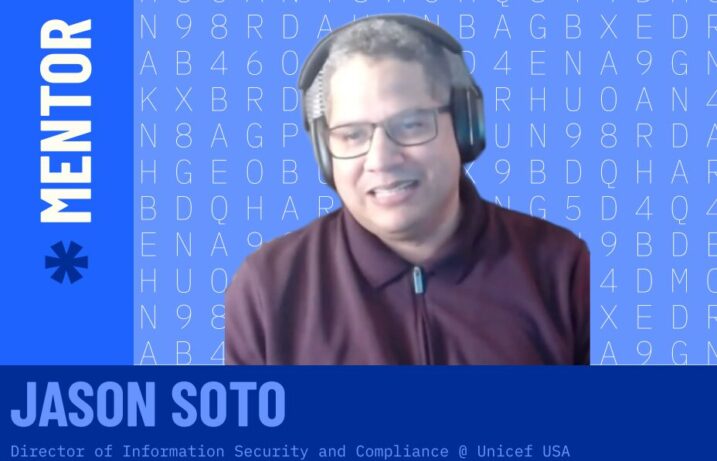
Meet Jason Soto
With 10+ years in cybersecurity, Jason serves as Director of Information Security and Compliance, leading cybersecurity initiatives across incident response, threat intelligence, threat hunting, and compliance. As part of a small team, he remains deeply involved in the hands-on work of protecting systems while embracing new technologies like AI to strengthen cybersecurity operations.
In his Meet the Mentor interview, he shares how curiosity led him from system administration into cybersecurity, where a fascination with Linux, offensive security, and threat intelligence shaped his career. He reflects on the mindset that has guided his growth, from junior security analyst to director, emphasizing continuous learning, innovation, and never becoming too comfortable. As a facilitator, he also discusses the importance of keeping students engaged, adapting to AI responsibly, and why staying curious is still the most valuable skill anyone can develop in tech.
Snapshot
Current Job Title: Director, Information Security and Compliance
Current Employer: Unicef USA
Experience: 10+ years of experience in Cybersecurity
LinkedIn: linkedin.com/in/jason-soto-b5211860/
Technical/Professional Skills: Ethical hacking, metasploit, shell scripting, penetration testing, cyber threat hunting, cyber threat intelligence, security architecture design, incident response
Teaching/Mentoring Experience: “I had a blog where I would always publish tutorials while I was learning system administration and cybersecurity. I had a write-up on Docker that gained a lot of interest and that kept me going. I’ve always had an interest in passing on knowledge. I did some teaching through short courses.”
Words of Wisdom: “You have to be excited about what you’re learning. Every area in tech is broad, especially in cybersecurity. There are many different paths you can take and areas where you can deepen your knowledge. The key is staying curious and being genuinely excited to learn.”
Favorite Part of Your Job: “What I like about facilitating is that you get a different perspective. People come in with fresh ideas and different ways of thinking, and they ask interesting questions.”
Q&A Transcript
Introduction: Who are you and what do you do now?
- Can you tell us a bit about yourself? What’s your role at Unicef?
- I’m Director of Information Security and Compliance at UNICEF USA, and I’ve been there for over 10 years. It’s a small team, which means we get to stay on the interesting part of cybersecurity, the hands-on work, which is the place I like to be. We are a team of three, and we are in charge of everything related to cybersecurity, including incident response, threat hunting, threat intelligence, and compliance, everything that falls under that realm of cybersecurity. I love working on a small team because it gives me the opportunity to wear many hats, stay active, and get hands-on across several areas within cybersecurity. That’s been the case for the past year, and that’s what I find very interesting about my current role.
- How has AI shaped your role in the last few years?
- AI is everywhere. I was joking the other day when we were at several conferences, and I said to my teammate, if anybody says AI one more time, I’m going to jump out the window. It was a joke, but the point is it’s just everywhere. But I have to say AI has changed the way we work. It has made us more efficient and faster. We’ve introduced AI into several of our cybersecurity operations, from threat hunting to threat intelligence to incident response. One area that used to take a lot of time for security analysts dealing with analytical platforms and SIEMs is generating queries, and testing them. We have reduced that time drastically by leveraging AI. If we need to focus our search on specific things, we use AI to generate queries and get started quickly. It has helped us in several other areas of cybersecurity operations as well. We use it as a force multiplier, I always say that if you’re leveraging AI, you have to be in the driver’s seat, and we try to keep it that that way throughout our operations.
- What are the key skills crucial to the workplace now?
- You have to be crafty with AI. You’re going to see more and more organizations leveraging AI heavily, so you have to get better at prompting. That’s what’s going to set you apart from someone who is not as hands-on. It’s also about how you think about it. How does AI fit into your current operations? Where can you integrate it? How can it help you reduce time and improve efficiency? It is not about letting AI do your job. It is introducing it into your daily workflow. If you do that, and it’s going to be a game changer.
Career Journey: How did you get here?
- Can you walk us through your career journey? What inspired you to pursue a career in tech?
- Several years ago, I was always interested in tech. My first role was in a help desk position, dealing with DSL clients for a communication company. At the time, I was working with with networking and some system administration, and I saw myself staying in that area, focusing on system and server administration. Then I moved a little bit into Linux operating system. That’s where I went down the rabbit hole. I started working with Linux, became more interested in it, and most importantly, became curious. That’s the key when you are in this field. As I worked with Linux administration, that’s when I shifted into cybersecurity because, through working with Linux, you’re introduced to several distributions. I came across Kali Linux, and that sparked my curiosity. I started experimenting with it, learning about security testing, and reading more about offensive security. That’s when I got introduced to Metasploit. At that point, I started asking myself, “If I can do all of this, how can I defend against it?” That question shifted my mindset toward the defensive side of cybersecurity. I began digging deeper into defensive security, and that is what ultimately brought me into this field. I’ve been here for several years now. Throughout that journey, threat intelligence became a big topic. If you ask me, threat intelligence is one of the most interesting topics in cybersecurity that always gets me excited. Going down that route, I got introduced to threat hunting. I could go on and on, but the point I want to make is that it all started by staying curious.
- How did you land in your current role?
- At UNICEF, I started as a junior security analyst. I was brought in several years ago as a junior security analyst, and when I joined, we had certain deployments in place. I’ve always looked for ways to improve what we currently have. Thankfully, we had leadership that was strong on security and open to new ideas. What started as a small cybersecurity program grew over time as we introduced new ideas and new solutions. That is what helped me grow into other roles, taking on additional deployments, up to my current role as director, overseeing everything we have built since I joined UNICEF USA. I often get asked, “Jason, we have all these things we want to move forward with. Are you comfortable with what we currently have in place?” My answer is always the same: I am never comfortable. That keeps me thinking and always looking for gaps that could become entry points for malicious actors. That’s basically my day-to-day. Year over year, we continue to improve our security posture and create a more robust cybersecurity program.
Lessons Learned: What have you learned along the way?
- What’s one lesson or insight from your career that’s stuck with you and continues to guide you?
- Always innovate. Don’t just stay where you are. My take is to always look for ways to make things better, make things more efficient, and improve yourself. Sometimes we get comfortable in a position and think, “I’m good here.” For me, that’s not a good place to be. Always look to improve yourself, either in your current area or by exploring other areas that excite you. I’m big on cybersecurity, but I also explore other things as a hobby and in related areas. That’s what I take with me all the time.
Mentorship: Why did you decide to become a mentor?
- How did you first get connected with Flatiron School, and what drew you to the school?
- One thing I’ve always liked to to do is pass on knowledge. Several years ago, before I moved to the US, I worked in the Dominican Republic. For me, 24 hours there are not the same as 24 hours here in the US. I feel like I don’t have the same time I had back then. I had a blog where I would always publish tutorials while I was learning system administration and cybersecurity. I had a write-up on Docker that gained a lot of interest and that kept me going. I’ve always had an interest in passing on knowledge. I did some teaching through short courses. When I came here to the US, I tried to maintain it, but as I mentioned, time feels like it moves much faster here, so I stepped away from blogging a bit. But, I have always been searching for opportunities to put my free time to use, whether through a podcast or a YouTube channel where I could chat a little bit. I remember seeing a posting for Flatiron School, I think it was on LinkedIn. I’m like, “This looks like a a good opportunity, let me go for it.” I remember applying for it and getting a call a week later from Cody. I had a quick interview and got my first opportunity with my first group. I think I’m about a year and a half in now, and I enjoy every group I take on. What I like about facilitating is that you get a different perspective. People come in with fresh ideas and different ways of thinking, and they ask interesting questions that sometimes make me thing, “I didn’t think of it that way.” That’s the part I enjoy most about facilitating.
- Do you have any tips for how you keep your students motivated when they’re taking on a fast-paced curriculum?
- It is a tough curriculum, but when you’re starting out, I like to tell students that the first couple of modules are your building blocks. You might find them a little boring at first, but stick with it because it gets more interesting as you move along. On top of that, I usually like to go beyond the curriculum and expand on the material. That’s the first thing I tell students on day one. I let them know, “Unless you have questions, I’m going to expand on it.” You will see additional topics related to the course but we’re going to go deeper and that keeps them engaged. Sometimes there is a lot of reading and a lot of quizzes, and people can start to feel discouraged or think, “Maybe this is not for me.” But there is usually a moment that really sparks their interest, and that is what I am always trying to find. You can see it when you are presenting or walking through a live scenario. You can tell when something clicks. Once that happens, I know that student is going to find what comes next much more interesting.
- If you could give one piece of advice to someone just starting out in tech, what would it be?
- My first one is to stay curious. I never stop saying that. Second, you have to be excited about what you’re learning. Every area in tech is broad, especially in cybersecurity. There are many different paths you can take and areas where you can deepen your knowledge. I think the key is staying curious and being genuinely excited to learn.
Future Focus: Where do you want to go next?
- What’s something new you’re learning or exploring right now, and why does it excite you?
- We are spending a lot of time learning about and working with agentic workflows. Before we even go too far down that route, my team is focused on the overall security around AI. We don’t want to start using or deploying AI solutions until we fully understand the security implications behind it and how to protect that at a broader scale. That’s our focus right now. AI is still new for everyone, and every day we learn something new that requires us to adapt. As I always say, I have never been afraid of a new challenge. It has been an interesting experience for both me and my team.