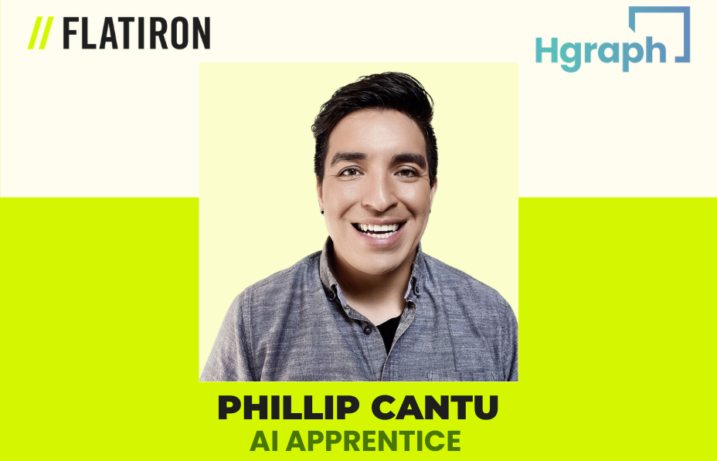
Meet Phillip Cantu
Phillip is a student in Flatiron’s Accelerated AI Engineering Immersive program and an AI Apprentice at Hgraph, a multi-chain infrastructure company providing APIs, indexing, and AI-native intelligence. He is currently working on building data pipelines and developing and improving GraphQL APIs.
In his interview, he shares his non-traditional path from the National Guard, culinary arts, and teaching to tech, describing how he hit the ground running at Hgraph and reflecting on how the foundations he built at Flatiron prepared him to contribute to building that powers products used by thousands of people.
Snapshot
Current Job Title: AI Apprentice
Current Employer: Hgraph
Past Employers: Varsity Tutors
GitHub: https://github.com/hereisphil
Website: https://www.phillipcantu.com/
LinkedIn: https://www.linkedin.com/in/phillipcantu/
Technical/Professional Skills: React.js, TypeScript, Next.js, Node.js, Express.js
Favorite Part of Your Job: “Providing new features or cleaning up data, or whatever it may be, whether related to user experience or even developer experience, for paying customers.”
Q&A Transcript
- Can you tell us a little about yourself? (Your name, background/experience, your Flatiron program, etc.)
- My name is Philip Cantu. I suppose I’m switching careers because previously I was in the military, National Guard for 6 years. I have an Associate’s degree in culinary arts so I’ve worked in kitchens, but for the most part, oddly enough, I’ve been working as an English teacher for quite some time. I’ve always loved tech, and so I’m finally chasing my dream, and I went with an apprenticeship in software engineering I’m currently in the AI & data science program at Flatiron and part of the work integrated program. So, Flatiron was able to successfully land me a job, so to speak, an apprenticeship with a legitimate US-based company, a remote job.
- Can you tell us about Hgraph and what your role is there?
- Hgraph is a small company in the U.S. Now we’re a team of six. It’s that small. They are a company that has their hands in blockchain, Web3 technology, so kind of crypto-based, but it is a web application. My main role is I’m assisting the senior software engineer with improving the web app. I’ve been in there for two and a half weeks. For the most part, I’ve been improving one single page of the app and kind of totally refactoring it. It began with something simple. Like my first day, I literally put a button. I put two buttons and made sure they were functional. But since then, we have ideas, and even I’ve thrown some ideas at him on how we can make the page more user-friendly, what the users of this app need, and then I go in there and figure out how to implement these features. Other things would be we have our own design system. Since we are a small team, we are everyone. We are the DevOps, we are the marketing, we are the product teams. We do it all. Recently I’ve worked in the design area because we use our own components. I’ve been helping build it with our API, so what we’re getting from our self-hosted servers. It’s really cool, it’s a really great experience, and it’s all fully rounded. It’s like a full-stack web application, but there’s definitely a lot of technologies in there that I’ve never seen or heard of or touched. But they’ve been guiding me really well, and it’s been going really well.
- What’s it like working on a small team versus other experiences you’ve had with other different team sizes?
- This will be my first experience with a software team. But compared to big teams, I think there’s definitely a lot less bureaucracy. But it seems more casual, but not casual enough to feel like it’s unprofessional. It’s still a very professional team. We meet with the CEO, everyone comes every Monday morning, and we have a meeting where we see the state our app and what everybody’s been doing. I don’t think you can do that if it was a big company. I can talk to and hear from the CEO and even from our main marketing guy, the one who is looking for more and more customers and clients. I can see in our private Slack channel what one of the guys is doing in New York for a big meeting. When I’m in this team, I feel like I’m a part of this, I’m making a difference, I’m making a change. And sometimes if it’s a big change, the senior software engineer will ask me to post a screenshot in our Slack channel. And then you see praise, like, “Oh, wow, this is really great.” Or when I shared this Monday, some of the changes, the CEO was like, “Oh, is that live now?” I was like, “Yeah, that’s live.” And he had to go check and it was just, I mean, I shouldn’t, I’m not tooting my horn because I am following their guidance, but it just feels good to see the top people in my company seeing the fruits of my labor.
- What types of projects are you working on, and how did Flatiron prepare you for this role?
- To get a little bit more into the weeds, we index a blockchain with GraphQL. There’s a lot of data, terabytes of data that we host on our website and our servers. We have to take this data and it’s all indexed, but there’s just so much, and we have to clean it up. And part of the Flatiron School, that’s what I’ve been doing a lot—data analyzing, learning how to analyze data. Look at data, what am I seeing? Be able to understand it. Data cleaning. Okay, maybe it comes in in this format. Maybe it was a date. Date and time. And it’s always in some crazy look. If you’ve never seen the way computers put the date time, it can be crazy-looking. So you can clean that up or trim it, making it, making the data pretty. Flatiron has helped a lot with me understanding how we deal with data and how we can manipulate data. That’s what we have to do because our users are constantly in their city, hundreds if not thousands of requests per minute for the data that they need for whatever they’re doing on their services. So they need to receive clean data the moment a request goes through on our app. And so I have to help make sure that those services on the back end are providing that data, and then on the front end, it’s nice and clean and appearing there. So it’s been a lot. I’m not gonna lie, I’ve had several headaches because there’s still a lot of new technology. But luckily, because of my education at Flatiron, even if I have never touched this technology, like GraphQL, I know the underlying principle of how to handle data. And so learning a new technology, once you have the foundation, is more of a breeze.
- What skills have proven most valuable since starting your apprenticeship?
- I did mention the daily cleaning, and that is very valuable, but at the same time, that’s not all my work, because I do a lot of front end, just adding new components. But since I was in the work- integrated program with Flatiron, and I had some time with the apprenticeship at Flatiron, honestly, I would say that was probably more valuable in this context, only because Flatiron immediately threw us in with a team. It was a team of four or three other guys whom I do miss and the app that we were making. But it was like week 1, where we had our mentor, Tony. Tony gave us this big repo. And for me, it was like one of the first time I’ve seen like, “Wow, this is a big repo.” And our first week, luckily, I’m really glad that I did this, where the first week wasn’t like, “Hey, add this to the app.” No, it was understand it. And they understood, this is probably the first time a lot of you are seeing a big repo, a GitHub repo, a lot of code, and maybe new technology for some of them. So for the first week, we analyzed the repo, we provided reports on it, and then we analyzed parts of it and how we can improve upon it. Those first two weeks were really good because when I had my interview with Hgraph, before my interview, of course, I did my due diligence. I played around with their app. And I recall my first interview, I immediately came with some opinions and some ideas on how their app can improve. And later, the senior software engineer confessed that he really appreciated that I came with ideas and that even if I don’t know the tech stack at that time, I came with like, “How about this? This is missing. What if we did this?” I think Flatiron, just working with the repo that we had there and building and eventually building the app at Flatiron, helped me better able to dissect other apps. And when I got hired, their repo was even bigger. It’s a big mono repo. It’s huge. I wasn’t as intimidated. I’m like, “All right, this is big, but I have a better idea of how to go into a brand new code base and dissect it.”
- Are there any other tips or recommendations you would give someone who’s interviewing for apprenticeships?
- Do your due diligence. Even if they say you don’t have to, like he said, “Oh, this is just 15 minutes.” Be in greet. I said, “No way. I’m going to do my due diligence.” And of course, I used AI. I asked Gemini, “Hey, what do you know about this company? Tell me more.” And then I signed up for a free account on their app. And I played around with it. I even saw their email marketing come in and everything. So do that. Have a better understanding of who they are, what they are. And yeah, I don’t know why I thought about it. Maybe because of the Flatiron experience. But I wrote down ideas. I just thought, if I’m going to go in there and help them, before my first interview, I had no idea what they would want me to do. I just wrote down things that I saw. I couldn’t see their back end, but I saw all the things on the front end. So I think come with ideas is a good one. And resume. He admitted to me, because I did ask him. Because I wanted to help my fellow Flatiron students. I asked him, because a lot of these employers will get a bundle or stack. I’m not sure how many resumes they’ll get to see at one time. But he said a lot of the students looked like they were AI written or the resumes were just put together hastily and not a lot of care. And he saw mine. Mine was, well, I did spend a lot of time on my resume. He said it was well formatted. It was clean. One page, still just one page. And to him, that gave him an impression like, okay, this guy cares about UI/UX, user interface, user experience, how things looks. And he’s like, we want someone that cares about how things look. So I’m sure there’s many more factors, but he did tell me that.
- How has exposure to AI & data science changed your perspective on what you can build?
- We do use AI. We are using Claude Code for a lot of our work here at Hgraph. But we also have human reviewers, of course, always. With our mentor, Tony, he gave us the go-to and the know-how, how to use AI appropriately, he gave us a PDF to download that we could follow for properly using AI and directing it to provide the things that you really want. And it’s never always going to be perfect, but still, even yesterday, Claude was going in a loop. I’m like, “All right, come on, Claude.” So you still got to know your foundations. You got to be able to hand-code sometimes. And then maybe you come back to AI, like, “Oh, I see what you meant now.” Understanding that AI is super powerful, it’s a super amazing tool, and I think it’s just obviously accelerating our development. For example, at the end of my first week, five days of Hgraph, I had a total of 9 pull requests that got accepted into the main branch. A lot of them were not huge, but that’s still a lot. If I had to hand-code all that, maybe it would have been one or two. So, realizing that it is a tool, knowing how to properly prompt it, knowing your codebase well enough so that it doesn’t just go haywire. For example, I need to remind it, “Hey, why did you build that button?” We have this button component. You need to use this button component. Of course, the more you use it with a specific codebase, the better. You want to understand how to prompt it, remind it every time, “Hey, be sure to use our components for this. Remember that the API is here, not there” or something like that. But it’s been an experience.
- What does it mean to you to be adding real value to an organization at this stage of your journey?
- I think it’s everything because especially now in 2026, I mean, people you hear it all over. It doesn’t matter what social media platform you’re in. There’s a lot of negativity about hiring right now and layoffs because of AI. And so to be able to find the team that does properly utilize AI, and tons of data and realize that they do need an extra hand, a real person and not another robot, and to go in there and to start contributing in meaningful ways. Then we have some big tickets that we’re working on. Although I don’t have firsthand experience on user reports, I feel like they’re going to really like this feature. And it’s there, live on the page. I keep that in mind to realize that I’m providing new features or cleaning up data or whatever it may be with user experience or even on our side, developer experience for paying customers. It’s really humbling.
- Do you have any advice you would give to someone who is just starting one of the work-integrated programs and learning how to juggle the day-to-day workload of coursework alongside working at a company?
- I think it just boils down to passion, because maybe some people do join the software engineering world because of the potential salary. Although I am excited about a potential high salary, that was never my reason for joining. I’ve just always loved tech since I was a kid. I had coding classes as a kid, but I’m not the prototypical self-taught coder. I would say this: try to get more involved. If I look at Slack and Discord channels that I’m in, university things, there’s my experience, whether it’s Flatiron or I did a certificate program at my university, all tech-related. My experience is that most students aren’t engaged. It’s very, very few. I’ve always been, and again, I’m not tooting my own horn, but it just seems to be that way. I seem to be one of the most engaged: asking questions, even though I know I can ask AI, I want to. Maybe I’ll do both. I will ask AI, and then I’ll ask the instructor, because I want to hear what the real-life experience of someone who has been doing this for 20+ years says about it. Just be engaged in all parts. Whatever you’re in, ask questions or even just share news. “Hey, I just learned about this new AI model.” There’s usually a channel for general discussions and then hopefully what happened to people is what happened to me. Maybe my first year at web development university, I wasn’t doing too much tech-related outside of my classes, but after some time, even though I still love tech, I love it more. Right now, if you scroll my X feed, you see nothing but tech-related stuff. I get nothing but tech. A lot of times I will show up to work and share something with my senior software engineer and I want to hear about that. Hopefully they stay engaged and study and practice.
- What are you most excited to learn or accomplish in the coming months?
- I am most excited to learn. I’ll put it in two parts. The Flatiron side, we’re going deeper into the AI modeling and I’m really excited to learn about the machine learning and how that works. I have no clue, I just have a basic inkling of it, so I want to see how that works and see if that can improve my own uses of AI. Since luckily we are self-hosted at Hgraph, maybe we can build our own AI model and save tons of money without having to use Claude. So there’s that. But on the Hgraph side, I’m only two and a half weeks in. There’s still a lot I don’t understand. I can’t explain everything. I’m just excited that eventually it’s coming to me to fully understand the page that I work on because there’s just so much going on. We have a proxy. We have the data, we have the front end page, and then the different APIs that we’re using. It’s just a lot coming together, and they they work really well. I want to know why are they working so well, how are they talking so beautifully to one another.