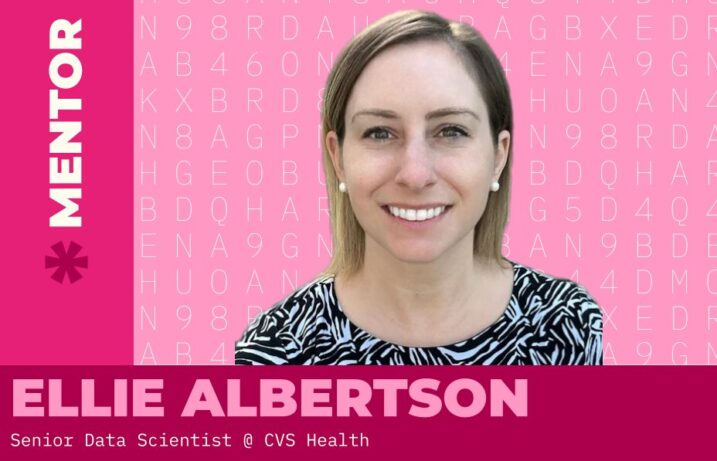
Meet Ellie Albertson
Coming from a nontraditional path into the field, Ellie serves as a Senior Data Scientist, working with diverse data sets. Her role has shifted with AI, moving from an applied statistician toward AI engineer, and she now uses AI both to support her daily workflow and to build data products that leverage AI.
In her interview, she shares how a background in public health shaped her path into data science. She reflects on the value of persistence, staying open-minded to different types of work, and treating technical and business skills as equally essential. As a mentor, she helps students push through the discomfort of not knowing something yet, and encourages them to stay curious about AI, which she sees as critical to a sustainable career.
Snapshot
Current Job Title: Senior Data Scientist
Current Employer: CVS Health
Experience: 10+ years of experience in AI, machine learning, advanced statistical analysis
LinkedIn: linkedin.com/in/elliealbertson/
Technical/Professional Skills: Agentic AI development, LLM, Python, deep learning, SQL
Words of Wisdom: “Technology is always going to change, and we’re never going to automatically know how to use the new technologies. So being able to learn and demonstrate that you can do it quickly is a big asset.”
Favorite Part of Your Job: “Developing data-related products and deliverables that leverage AI. For example, I look at places where we can leverage agents, agentic technology, or large language models in other ways.”
Q&A Transcript
Introduction: Who are you and what do you do now?
- Can you tell us a bit about yourself? What’s your role at CVS Health?
- I’m a senior data scientist, and I came into data science through a less common path. Nowadays, there are degrees in data science, computer science, and programs like Flatiron. But when I was in college, data science was not a bachelor’s degree option yet. So I actually studied public health and then focused on quantitative statistical methods. When I got out into the workplace, data science had really ramped up as a field. I got an internship at a hospital on their data science team, then went to work for a health tech startup for a little bit, and then came over to CVS Health. They have many data science teams doing a lot of very cool work with health data, but also with data from other aspects of the business, like finance, marketing, etc.
- How has AI shaped your role in the last few years?
- My role has changed a lot since AI became available for commercial and business use. I currently use AI in two ways. One is in my hands-on-keyboard work with coding and also by incorporating it into my workflow. So, really, I use AI to help with my day-to-day work tasks, whether that’s coding or other applications. The other way I use AI is, as a data scientist, by actually developing data-related products and deliverables that leverage AI. For example, I look at places where we can leverage agents, agentic technology, or large language models in other ways. It’s interesting being in data science right now. My job has changed from being basically an applied statistician to being much more of an AI engineer. But I think that’s happening to a lot of professions now. So the more we know about AI across all professions, the better, I think.
- What are the key skills crucial to the workplace now?
- I usually think about data science skills in two buckets. One is the technical bucket. We need to have a foundation in coding, databases, cloud technology, analytics, and statistics. That’s always going to be important to understand, even if AI starts taking a bigger role, because we need to be able to validate what the AI is doing and help the AI do it as efficiently as possible. Technical skills are really important. The other half of the skill set for data science, especially, is the business skills, or soft skills. People talk about communication a lot, but I also think it’s about learning how to be influential, understanding the business context. What are the drivers of value for wherever you’re working, whether that’s a nonprofit hospital, where I used to work, versus a for-profit company. Figuring out how we can not only do high-quality analytics and leverage technology, but also figuring out how we can inform business decisions with those analytics and make our work as valuable as possible. I think that’s really the key to thriving in data work long-term: becoming a business asset.
Career Journey: How did you get here?
- Can you walk us through your career journey? Were there any pivotal moments?
- I mentioned earlier I don’t come from a traditional data science background. I work with a lot of people who have degrees in statistics, computer science, or both, and my background was actually different. My undergrad was in environmental science, so not data science related besides the scientific and quantitative aspects. I’m glad I got a science degree because it exposed me to scientific thinking, and I also gained experience with GIS, so geographic information systems, which is still really valuable today. Then I went to grad school to study public health, with a focus on quantitative methods. Between undergrad and grad school, I had done data work and data analysis in the nonprofit sector and in public social services, like at an affordable housing agency. So I knew I wanted to do something in grad school that would set me up to continue contributing in that setting, while also giving me exposure to healthcare data, which I was really passionate about and interested in. So I went back to school and studied a lot of biostatistics and epidemiology, which, again, is not a traditional data science route. But if you want to work in the healthcare sector, I think that’s a still a really great path, honestly. I graduated, got an internship at a hospital near where I live on their data science team, and then have snowballed from there. As far as pivotal moments go, it’s really been a lot of small steps adding up for me. I don’t know if there’s been one defining moment. I’ve been really lucky that I’ve had some incredible team leads and managers who believed in my potential and gave me the chance to learn on the job. I know that nowadays, with how competitive the data science field has become, that doesn’t happen as often. But as you’re looking for jobs, I would still encourage you to keep an eye out for people who are going to believe in you and give you the chance to learn. Technology is always going to change, and we’re never going to automatically know how to use the new technologies. So being able to learn and demonstrate that you can do it quickly is a big asset. I think that’s something I was able to do, and it’s what allowed me to keep progressing in this field.
Lessons Learned: What have you learned along the way?
- What’s one lesson or insight from your career that’s stuck with you and continues to guide you?
- The biggest lesson I’ve learned in data science is to persist. Don’t give up. Be be able to pick yourself up and keep going, even if you hit what feels like a wall at the time, because there are a lot of ways to get into data work. I came from a non-traditional route and landed in data science. There are also so many job opportunities that are adjacent to data science, where you can move between data science and roles like data engineering, database administration, or analytics engineering. Just because you’re not getting the exact job title you want to start with, or you’re running into challenges with a team or a company, don’t give up. Definitely keep going. It’s a really great field. It offers a lot of opportunity, and if it’s what you want to do, then play the long game and keep going. It’s worth it.
Mentorship: Why did you decide to become a mentor?
- How did you first get connected with Flatiron School, and what drew you to the school?
- I was looking for opportunities to teach. I had been looking at part-time lecturer opportunities at more traditional universities and community colleges. But I realized that I didn’t really want to be in a formal, traditional academic setting. I thought teaching for something like a work-integrated program, or something more flexible and nimble that could keep up with the field, would be a better fit for me. So I found Flatiron. The opportunity seemed like a great fit. I really enjoy sharing what I’ve learned and also learning from the experiences and paths of the people who I work with as Flatiron students. A lot of them are career changers. Some of them are just starting their careers. But whatever path they’re on, I can take what they’ve learned and share it with others as well. It’s fun to get to know what people are experiencing and, hopefully, help them avoid some of the mistakes I’ve made in the past so they can have a more efficient and streamlined path into this field moving forward.
- What’s the most rewarding part of facilitating so far?
- I like helping others learn, and I also don’t want data science to be a field where there’s a lot of gatekeeping. I think it’s important that it be available to everyone because these are tools and technologies that can make a really big difference if we know how to use them and have access to them. That’s important to me.
- Do you have any tips for how you keep your students motivated when they’re taking on a fast-paced curriculum?
- It’s a two-way street. I think I need to do my part, and students need to do theirs. I think part of the learning process is learning how to push through the difficult parts. That’s just part of what data science is. It’s really rare that we’re handed a handbook or a rule book that tells us how to do something. Usually, we have to figure it out, hit a lot of roadblocks, encounter a lot of dead ends, and communicate that to stakeholders in effective ways. So part of the learning is to learn how to do that and persist. From my end, I try to be available, communicate, and encourage people. I also try to let them know that it’s very normal to not know how to do something. I think sometimes assume that everyone has coding experience, but they don’t. The other thing is just knowing what resources are out there. I try to provide a lot of resources that are targeted to specific use cases. So if you need help with this, go to resource A. If you need help with that, go to resource B. AI has created other opportunities for learning, and I try to help guide students on how AI can be helpful, but also how it needs to be used cautiously.
- If you could give one piece of advice to someone just starting out in tech, what would it be?
- One piece of advice for someone starting out in tech is to stay open-minded. Sometimes people hear about data science because it’s a really well-known profession these days. A lot has been written about it. It’s a buzzword. Maybe AI is starting to replace that, but we still hear about data science all the time. In tech, there’s so many other roles that are also very important and really interesting. So I would say stay open-minded to things like product management, data engineering, even software engineering. If you really like the coding side of things, you can build up your skills and become a data-oriented software engineer. Or, if you’re more into the people side of things, there are opportunities in people management, finance, operations, and so much more. You can work in technology and have a very stable, AI-proof career that doesn’t necessarily have the job title “data scientist,” while still applying your data science knowledge and skills on a daily basis. Stay open-minded. Focus more on the type of work you’ll be doing than the job title, and I think you’ll find a place where you can be happy for a long time.
Future Focus: Where do you want to go next?
- What’s something new you’re learning or exploring right now, and why does it excite you?
- I am really a specialist in healthcare data science. I have the quantitative background, as well as the cloud computing and machine learning background, but my business expertise is around healthcare. An area that is starting to interest me more and more is the life sciences side of healthcare, things like pharmaceutical data, medical device data, biotechnology data, and how our healthcare system, especially in the United States, interacts with that industry. There are many data standards and types of analyses involved. There’s a whole field called real-world evidence, as well as health economics and outcomes research and health technology assessments, that become much more relevant on that side of the data science world. Historically, those were separate from data science. They were treated as statistician exercises, but more and more data scientists can contribute there, and that’s an area I’m exploring more now.
- Are there any projects or goals you’re currently working on that you’re particularly passionate about?
- I feel like outside of work right now, when I do have time for professional development, I am trying to build more business and contextual knowledge around healthcare and the life sciences. The other area at work that I’m really digging into more is using AI, and specifically using agents or agentic technology to do analytics. We’re starting to see opportunities for natural language inputs, where we as humans ask the AI for things. We’re starting to see opportunities for that to actually generate useful analytic outputs. It’s a little scary because maybe I’m working myself out of the job, and I don’t love that. But also, I think there are opportunities there, and getting ahead of the technology is important if we are going to be sustainable in this type of work. I’m exploring it. I’m learning how to implement AI and agents in cloud platforms. So those are things like Google Cloud platform, Microsoft Azure, and Amazon Web Services, AWS. I’m curious to see where this goes. Specifically, using AI to write SQL queries and write Python code is an area of interest for me.