Welcome to the eleventh episode in our “Meet the Mentor” series where we get to know Flatiron School mentors in an interview-style conversation. Whether you’re just starting out or looking to level up, these stories are packed with practical advice, encouragement, and insights to help you navigate your own path in tech. Each article includes a mentor snapshot + links to follow their work, their video interview, and their Q&A transcript with links to any references.
Follow along and discover the people shaping the future of tech, one student at a time!
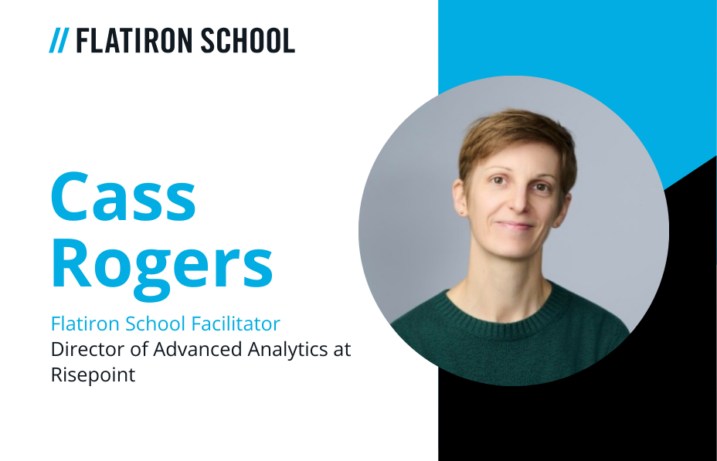
Meet Cass Rogers
Driven by her love for shaping data strategy, Cass Rogers brings over 10 years of data science experience to her work as a director of advanced analytics, helping K–12, higher ed, and nonprofit sectors build pipelines and data products to enable data-driven decisions.
In her Meet the Mentor interview, she shares how her journey from academia to data science leadership shaped her passion for improving the student experience, why mentorship plays a critical role in helping people break into tech, and how AI and the accessibility of machine learning are transforming the way teams work.
Snapshot
Current Job Title: Director of Advanced Analytics and Flatiron School Facilitator
Current Employer: Risepoint
Past Employers: Uncommon Schools, New Jersey Institute of Technology, Cardiff University
Experience: 10+ years in Data Science
LinkedIn: https://www.linkedin.com/in/cass-rogers/
Technical/Professional Skills: SQL, Python, R, dbt, Fivetran, Airflow, Redshift, Snowflake, Tableau, Power BI, GitHub/GitLab
Teaching/Mentoring Experience: Cass has mentored in multiple capacities, including providing career guidance at universities and offering part-time mentorship in data science and data analytics.
- Graduate Tutor for Psychology Undergraduates
- Career Mentor for Cardiff University
- Data Analytics Track Mentor – SpringBoard
Other volunteer roles:
- Catchafire
- Prometheus
Words of Wisdom: “It’s okay to try and it’s okay to fail and just give it a go.”
Favorite Part of Your Job: “Being able to offer that subject matter expertise to those that we support.”
Meet the Mentor Interview with Cass Rogers
Q&A Transcript
Introduction: Who are you and what do you do now?
- Can you tell us a bit about yourself and what you’re working on these days?
- So I actually just changed roles into Risepoint. And so I’m working on getting onboarded and also in meeting a lot of folks, particularly on the student success side. That’s going to be the core focus of my role: just working with those teams to really improve the student experience for those that we serve. My role is going to be pretty strategic in terms of the projects that we’re taking on for data science. We’re doing a lot of machine learning and we’re really trying to upskill the teams that we serve in terms of the AI capabilities. So we’re looking to not only generate predictive models, but really bring them to kind of day-to-day use for the different teams so that those models can help inform the decisions that they’re making.
- How has it been shaped by AI and what excites you about this?
- Definitely when I’ve been in individual contributor roles, AI has just allowed me to work at a much faster pace. It’s really like having a sidekick that can help you expedite the things that you would have maybe done anyway, but would have taken a little bit longer. I think the other thing is that being in a centralized analytics function, we work with a lot of stakeholders, and the questions that they come with now are different. They’re like, oh, how are we using AI? How can we start using AI? And the role in analytics has always been focused on guidance and enabling stakeholders, and just having different conversations with them now that the landscape has changed. One thing that excites me is how excited everyone else is, but being able to offer that subject matter expertise to those that we support. I think one of the things I’ve always tried to do in working with data scientists is making sure that when we produce something and roll it out, we’re really communicating any limitations of that. I think with AI, one of the things we really need to think about is how we can explain to our stakeholders and end users how bias might be impacting those models and where it’s okay to use it and where we need to be more critical in its application.
- What are the key skills crucial to the workplace now?
- I think the willingness to learn is something I’m always looking, especially when thinking about hiring. But I think that just having very much an openness to that seems really critical. And I think also an openness to the way that we’re working is changing. If I think about someone who I might have hired 5 years ago and what I would expect them to bring into the role in terms of technical skills, I might have expected much more in terms of their foundational abilities, and maybe now I feel that wouldn’t necessarily be as much of a critical requirement given the use of AI in the workplace.
Career Journey: How did you get here?
- Can you walk us through your career journey? What were some of the pivotal moments that shaped your path?
- So at one point I was very much on an academic route. I had done my bachelor’s and my master’s and I was studying for a Ph.D., And during that time, while I was a graduate student, I got really involved in the student experience. I joined committees that were meant to take feedback back to the university I was at and let them know what was going well and what wasn’t. And in doing that, I saw various differences across the university. And I thought, well, this doesn’t seem right, right? It seems like everyone should have the same resources and expectations. We’re all paying the same amount of money. The degree we’re all trying to get at the end is categorically the same kind of degree, even if the subject matter is different. And so that really led me to become very passionate about the student experience. And I know that education for myself has been very transformative. It’s opened a lot of doors for me, and I want other people to also have access to that. And so as I was wrapping up my studies, a job came up at the university I was studying at to work on their policy side, really take that a step further in order to collect data and run surveys to really understand what was going on across the institution and then have the ability to take all that data and findings to committees and make recommendations. So that was really rewarding. The one thing that that role lacked for me was the ability to use my full technical skill set. I’d done a lot of coding and statistics during my studies and I wanted to be able to use that in the same type of role, but I just didn’t have the scope for that. That’s actually what brought me over to the US and started working at a university here where it was the internal business analytics, looking at student retention, student graduation rates, those high level KPIs. And that was good. It was good, but I still wanted to be more technical. I wanted to be surrounded by a full technical team and have the opportunity to work much more efficiently. I felt like there were some limitations to what I could achieve on my own in that environment. And so I moved over to K-12 analytics, looking at students a little bit younger, and really got to work in that fully technical team. We were all coding together and using GitHub together. It was great. I really enjoyed it. I then took a bit of a step back from that after moving into a leadership position. I just had two young kids at home and wanted a little extra time with them and was able to do some part-time consulting during that time. And then more recently I moved over into this analytics role at RisePoint, which I think really combines all the things I’ve been interested in for many years now, the educational piece, as well as the advanced data skills, as well as the stakeholder communication. That’s something that I really enjoy. And I like being in that centralized function where you do get that exposure to what’s going on across the business and really being able to go in depth with lots of different stakeholders on lots of different problems.
- What inspired you to pursue a career in tech?
- So I think that I would say that in terms of formal classes, that has not been my journey. My journey has started off on a sort of academic route where it was very much learn what you need to learn to do your thesis. But I think that served me well. Now I’m like, oh, I’m sure I could tackle anything if I learned to code from scratch. And so that’s been very good to have that grounding for myself that if I need to know how to do something, I can make it happen. And it does make me very solutions focused with with the work that I do. I’m never like, oh, well, I haven’t used that tool before, or I don’t know, I’m just gonna dive in and get something working and get the feedback and move forward.
- Did your education play a big role in your journey?
- It really evolved over time. The first coding experience would have been toward the end of my undergraduate studies, so I was running psychology experiments, but in order to create the experiments, these were all visual computer-based experiments. I learned to code in Matlab initially and then I learned to code in Delphi Pascal, and that’s kind of like an object oriented language, which was my foundation for then moving into more high level things. And then on the statistics side, I was using SPSS for statistics, which has some syntax capabilities. But then in terms of learning SQL and stuff, that wasn’t until much later, after I finished studying, and that’s when I was in a sort of workplace environment, learning SQL and pulling data every day to answer different queries with different questions.
- What’s your perspective on tech education today? What is the value of a bootcamp compared to other options like teaching yourself or getting a masters, associates, or 4-year degree?
- I feel that all are valuable because they allow lots of different entry points depending on where you’re starting. For example, you might have a bachelor’s degree, but it might be in a slightly different field and you want to pivot into tech or you want to pivot into data science. I think it’s great that there are so many options for people to do that. I do think that depending on the approach that you have or even just the structure that you have in those programs, there might be some that are a better fit than others and those that do have, I really like mentoring, as you may have guessed. I think the ones that do have that more holistic support that’s available for students can provide real advantages, especially where that’s then tied to career readiness, career skills that are really going to help you when you then go to look for the job. Having worked at universities where we would have a lot of computer science graduates and data science graduates, that’s often the hard part. Not only do you have the foundational skills and the practices from doing various group work and things during your studies, but then translating that into a workplace where everything is maybe a little bit less neat. There’s an urgent deadline and how do you navigate going from one to the other? And I think especially in a tight job market, you need to be able to demonstrate that you can do that, not in a vacuum of just within a course where there aren’t necessarily the same risks.
Lessons Learned: What have you learned along the way?
- What’s one lesson or insight from your career?
- I think this is going to be with the thing I already mentioned, which is learning to code from scratch with not many resources at all. This is when I was studying and no one else was working on the same PhD topic that I was. And it taught me that I if I was determined enough, I could do it, even when it was really, really hard. And I do genuinely think that there were so many lessons from learning to code in different languages. Every time I repeated that, I became a lot more comfortable with failing. And so maybe that answers one of your other questions that knowing that it’s okay to try and it’s okay to fail and just give it a go. I think that really sticks with me. And I think I do tend to bring with me that can-do attitude, even if I don’t know exactly what the final solution will look like. It’s like, okay, I mean, I know enough to kind of be like, oh, there will be a path forward here. We might just need to try a few things out before we get to it.
Mentorship: Why did you decide to become a mentor?
- How did you first get connected with Flatiron School, and what drew you to the school?
- So I had heard about Flatiron anyway, but I used to work quite closely with some people who had been through Flatiron School and then they worked at the company I was at. And so I knew what the training produced. I knew the quality of the people coming out of it who had pivoted from a different background into data. And so I thought quite highly of it already from those experiences of people I knew who’d been through it and were off on their way on their new tech careers. So that was kind of the reason that it was Flatiron School. And then in mentoring in general, I had done some career mentoring for the institution I studied at in the past and had really enjoyed it. I’d done some other sort of data science, data analytics mentoring part-time. So it’s always something that’s kind of on my radar that I like to be involved in. And just really enjoy the relationship building and the support that I can give others.
- What inspired you to become a mentor (cohort facilitator)?
- I think I just feel that it is so important to have someone in your corner. And I hope that in some way I can play that role for people that I mentor.
- Was there someone who influenced your career path and who (knowingly or unknowingly) mentored you?
- There was a manager I had at that first job after I finished my PhD who was really a very, very good manager and really taught me a lot about working in a university and much of the bureaucracy that goes into that. But also, I think they supported me and wanted the best for me, which I think even as I left the role, we still keep in touch now. And so it’s been really nice to have that consistency. And I would say that has been the case in many places I’ve worked, that there’s often been someone who has played the role of a mentor, and even when I have left the organization, has always reached out to see how I’m doing. And I think they have also been helpful at those times when you are applying for jobs and you need a reference. And I think that just having someone who wants the best for you has been really a privilege.
- What’s been the most rewarding part of mentoring students so far?
- I think it’s about, or the thing I’m not sure if it’s the most rewarding, what I feel maybe has the most impact in the role of a mentor is being able to talk through the nuances of how to apply something. I think that this is something I remember from when I was studying. We would have people come in and talk about leaving academia, like it was some crazy idea that you wouldn’t just carry on doing research for the rest of your life. I think that there’s a difference between, from a statistical standpoint, what the correct method is that you can apply in this given scenario, and then what we actually have to work with, how good the data is, and what the stakeholder wants to do with this information. Being able to bridge the gap between those two things, between the the core knowledge that somebody might have about a topic or a methodology and how we can actually apply that in the real world. I think that nuances are one of the things that I think is most critical to try and communicate and talk through with those who are looking to move into data science, in order to help them understand that it’s not always going to be nice and neat and clean. And I know that there’s always data cleaning exercises and things, but I think a lot of the time when people come into companies, and this has happened to me too, you’ll come in and you’ll be like, okay, so everything’s all nice and neat and organized and everything. And you come in, it’s like, everyone’s working on CSV files and it’s all kind of a bit messy and gnarly and scrappy. But I think just being able to have a better understanding of what the reality might be.
- How do you keep your students motivated?
- I think it depends on the student. Some people have more internal drive, motivation, or goal-setting that help them stay on track regardless of what happens. And then for others, it’s important to have that conversation with them. Like, what can I do that will help you? I’m always trying to know, do they have other commitments? What else is going on that could impact their progress to support them in that? And for example, if they need to take a pause or thing, I know a lot of courses offer them the ability to pause and then resume, which may be better for them rather than struggling through if they don’t necessarily have the time to commit at that moment. And ideally, I want to be able to have an open conversation about how to keep them motivated, but I’m also big on accountability. So, right, okay, let’s talk about next time we meet what we’re going to have done. And then if it comes to that point and it’s not done, then I want to go through and understand what had happened and if there was anything else they needed or anything they struggled with. Whether there’s any more communication structures we can put in place, like is it helpful for me to send you an email and check in between our meetings that kind of thing.
- If you could give one piece of advice to someone just starting out in tech, what would it be?
- I think my advice would be find a problem or topic that is exciting for you. Actually, the Flatiron ones are really great because a lot of the time you get to choose a data set or something. And that’s always my advice in mentoring: choose something you care about. Choose something that’s really interesting to you. It’s going to make it feel so much easier. It’s also going to feel like you’re learning something and working with something you care about. And I think that has always been important to me. In the work I do, I really care about education and student experience, and that gets me excited and makes me want to do a great job and dive into problems. So I think find something that’s interesting to you and use that as your pet project.
Future Focus: Where do you want to go next?
- What’s something new you’re learning or exploring right now, and why does it excite you?
- I’m learning a lot. Marketing has been something I’ve touched lightly or maybe a little bit from a distance. My role sits within a marketing and strategy division, so I’m learning a lot about marketing, which is new for me, but it’s really exciting. It’s just a different kind of data I haven’t worked with before. I’m kind of agnostic to what the data is, but just having all these new pieces to play with is exciting. Another thing that’s new for me is that I’ve only ever worked at educational institutions or nonprofits. This is a for-profit company, so that’s new for me too. I’m not recognizing a lot of change in that yet, but we’ll see how that evolves. And I think those are the main things.
- Are there any projects or goals you’re currently working on that you’re particularly passionate about?
- I think just taking existing data sources that we have, which could be anything from call logs or academic records, and trying to make sure that we’re really harnessing the information within all that data in a holistic way, right? So we want to make sure that we’re not having one team looking at this metric over here and one team looking at a metric over here and just trying to make sure that everything is cohesive and coordinated in a way that’s actually going to mean that we have better outcomes for the students at the end of the day. We’re not being too selective in what we’re looking at a specific point in time. We want to make sure we’re thinking about it across that entire student journey.
- Looking ahead, what’s a big dream or ambition you’re working toward in your career?
- I don’t know if I have a big one right now. I feel pretty happy with where I’m at, but I would just say really settling into this role and helping to build out the vision for advanced analytics at the company. I feel like this is the right place for me and I feel like there’s a lot of opportunity to grow and to learn. And so I just kind of want to stay on that path and invest in that for myself and for the company.
Lightening Round Questions
- What’s something you’re listening to or reading right now? (It can be any genre and can be a book, audiobook, or podcast.)
- I’m not reading it yet, but I ordered it today. It’s the new Booker Prize winner. I ordered it last night when I saw it from the library. It’s called flesh and it’s like a Hungarian British story so I’ll see what it’s about.
- What’s one product or tool you’re into right now?
- I don’t think I have a good one right now. I’ll just say Teams because I feel like I’m currently learning all the keyboard shortcuts for Teams.
- When is your next cohort?
- I don’t have one scheduled. I know they’re going to reach out about availability in November, December so I’m waiting on that.
- Where can listeners find you?
- LinkedIn is a good start.
- What made you smile this week?
- We rearranged all the furniture in our house. We got a new couch and stuff. And our two kids were just really excited about all the changes. And my daughter decided to rearrange her room. And so she rearranged her entire bedroom and it looks really great. And she’s so excited and proud of it. So that’s one of the things that made me smile.